Carpenter ant and wood-boring insect remediation requires distinguishing structural excavation from dietary consumption. Unlike subterranean termites that ingest cellulose, carpenter ants excavate smooth, clean nesting…
Carpenter ant and wood-boring insect remediation requires distinguishing structural excavation from dietary consumption. Unlike subterranean termites that ingest cellulose, carpenter ants excavate smooth, clean nesting galleries inside structural wall plates, subflooring, and window headers, leaving behind coarse piles of wood shavings mixed with insect fragments known as frass. Across Multnomah County, infestations concentrate heavily where persistent Pacific Northwest rainfall penetrates exterior envelopes. Older Douglas fir framing in Craftsman homes throughout Hawthorne, Laurelhurst, and Richmond frequently develops subterranean moisture pockets behind aged gutters, providing the softened fibers required for primary queen nests. Meanwhile, dense tree canopies in the Alphabet District (Northwest Portland) and Goose Hollow allow secondary satellite colonies to travel along overhanging branches directly into attic venting.
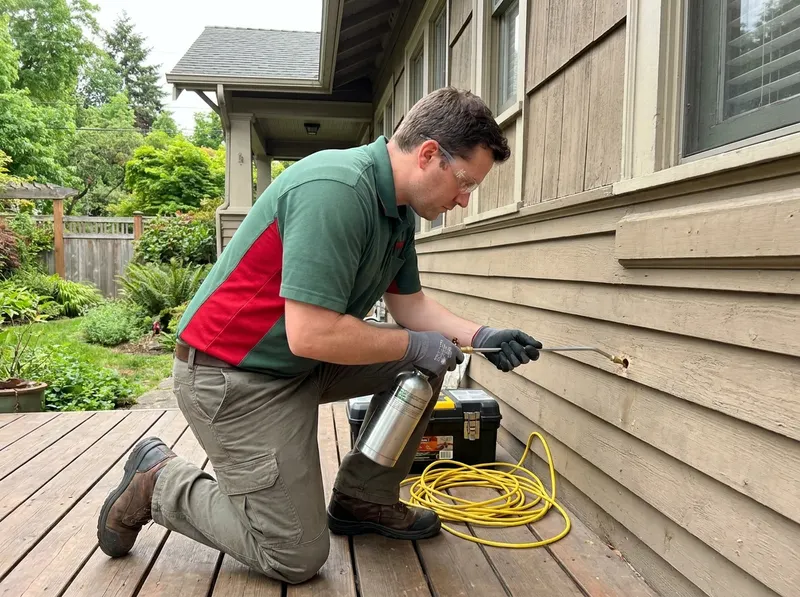
Selecting localized non-repellent injection fits scenarios where satellite activity is isolated to an addition or bathroom subfloor with under 15% structural moisture readings. In contrast, whole-structure remediation becomes necessary when multiple satellite trails establish foraging pathways between exterior landscape retaining walls and internal ceiling joists. The operational trade-off centers on treatment scope versus disturbance: localized void drilling addresses an active kitchen bay with zero disruptions to adjacent rooms, but leaving secondary nests untreated outside the footprint allows reinvasion within 12 to 18 months. Whole-home protocols seal exterior utility penetrations and deploy perimeter non-repellent transfer chemistry, which worker ants carry back to eradicate the parent queen located outside the dwelling.
Remediation protocols follow a sequential process to ensure resident safety and structural protection. 1. Acoustic and thermal assessment isolates void galleries within damp crawlspaces or perimeter sill plates without destructive drywall removal. 2. Low-impact micro-injection applies targeted transfer agents directly inside identified gallery chambers, preventing airborne chemical dispersal into living areas. 3. Physical exclusion repairs gap clearances around ledger boards and attic soffits exceeding 0.25 inches. 4. Moisture remediation guidance provides specific target drying measures, as wood containing below 12% moisture content naturally resists carpenter ant nesting and wood-boring beetle re-infestation.
Every job gets a firm, written price after a free on-site visit.
Tell us about your carpenter ant and wood-boring insect remediation job in Portland and we'll send a clear, written quote, usually the same day.
 Marvexa Pest Relief