Rodent entry into living quarters along Multnomah County residential corridors stems directly from Portland's persistent moisture and older construction styles. In historic neighborhoods like Laurelhurst, Eastmoreland,…
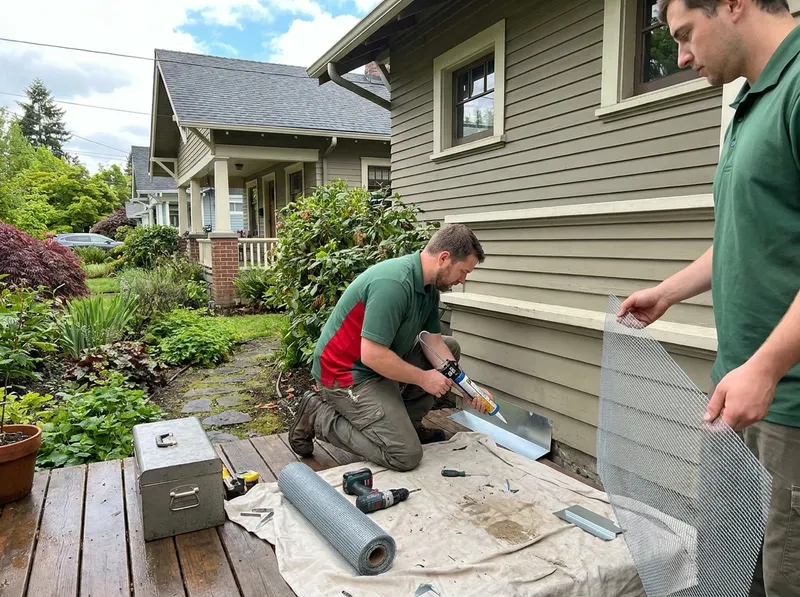
Rodent entry into living quarters along Multnomah County residential corridors stems directly from Portland's persistent moisture and older construction styles. In historic neighborhoods like Laurelhurst, Eastmoreland, and the Alphabet District (Northwest Portland), craftsmen homes and Victorians feature stone foundations, tongue-and-groove siding, and unsealed perimeter sills that settle over decades. Roof rats consistently exploit overhanging branches near Laurelhurst Park or Forest Park to access soft roof transitions, dormer corners, and ridge vents. Norway rats burrow into cracked basement foundations or loose perimeter skirting in river-adjacent zones like Sellwood-Moreland and St. Johns, entering crawl spaces and gnawing electrical lines and subfloor insulation.
Structural exclusion stops pest activity without introducing broadcast anticoagulant rodenticides that present secondary poisoning risks to neighborhood pets, raptors, and garden wildlife. While chemical baiting temporarily knocks down interior populations, it leaves entry pathways open, which guarantees re-infestation within months as seasonal rains push exterior rodent colonies toward warm foundations. A targeted Integrated Pest Management (IPM) exclusion approach physically blocks every opening 1/4-inch or larger, the space a juvenile mouse needs to enter, using heavy-gauge metal materials that rodent incisors cannot chew through.
Selecting a localized exclusion protocol versus a perimeter-wide structural wrap depends on the age and architecture of the building. For newer or slab-on-grade homes in Montavilla, Alberta Arts District, Richmond, or Hawthorne, rodent access is frequently concentrated around utility pipe penetrations, dryer exhaust vents, and crawl space access hatch gaps; spot exclusion addresses these specific zones with lower labor time. For steep-sloped properties in Goose Hollow or multi-story structures bordering heavily vegetated corridors, full-envelope exclusion is necessary. This protocol seals roof returns, chimney flashing, soffit intersections, and foundation lath boards. The trade-off between localized repairs and complete building envelope defense involves upfront material and access labor against the operational risk of recurring attic re-entry.
Every job gets a firm, written price after a free on-site visit.
Tell us about your rodent exclusion and structural sealing job in Portland and we'll send a clear, written quote, usually the same day.
 Marvexa Pest Relief